Protective ground transportation, explained in detail
The answers below cover how P1 selects and trains its drivers, how vehicles are certified and equipped, how each trip is briefed, tracked, and supported, how membership works, and where P1 operates. If your question is not covered here, the operations center can answer it directly.
The service
P1 sits between conventional executive car service and a full executive protection detail, adding protective capability to routine executive travel. This section explains what that means in practice and what every trip includes.
Protective ground transportation is executive travel delivered by a trained security professional rather than a chauffeur, with every trip planned in advance and monitored until the principal arrives. It sits between conventional executive car service, which is built around hospitality, and a full executive protection detail, which brings agents, advance work, long minimums, and significant cost. Each P1 trip pairs a security-trained driver with a certified luxury SUV and includes a Movement Brief, real-time tracking for the people you authorize, and the support of a 24/7 operations center. Every trip is paid from one prepaid membership, and the standard is the same in every market.
The main difference is the driver, who at P1 is a security professional rather than a chauffeur. Executive car services vet and train their chauffeurs, and that has real value, but the role is built around hospitality and driving. P1 drivers typically come from law enforcement, the military, or executive protection, and every driver is trained in protective driving, emergency medical response, and working alongside a security detail. Drivers are assessed in a fixed order of priority that begins with judgment and protective driving; armed capability comes last, as a final contingency, and drivers are armed where lawful and appropriately licensed.
P1 is designed for the many trips that call for a capable security professional at the wheel but not a full protective team, such as an FBO arrival, a dinner, or a day of meetings. A full detail of agents, a security driver, and a vehicle remains the right choice for some days, and it typically comes with long minimums and a cost to match. When a day calls for more, additional close-protection and advance agents can be added to a P1 trip, and when your principal already has a detail, P1 works alongside it.
Every trip includes a security-trained driver, a certified luxury SUV, a Movement Brief sent in advance, real-time tracking for the people you authorize, flight monitoring for aviation pickups, and oversight from the 24/7 operations center. Each vehicle carries an AED, a professional trauma kit, secure Wi-Fi for the principal, and a Principal Kit stocked to the principal's preferences. All of this is included with every trip, and no gratuity is expected.
No. P1 has no service tiers, so every member receives the same drivers, vehicles, and safety standard regardless of the size of the account. Larger accounts may be offered administrative features, such as additional reporting, API access, or custom billing, but never a different standard of driver or vehicle.
The operations center monitors every trip around the clock and acts when anything departs from the plan. Each trip moves through timed checkpoints, from the driver's assignment and the Movement Brief through the driver's acknowledgment, the vehicle readiness check, departure for the pickup, and staging on arrival. The team is alerted automatically if a checkpoint is missed, a flight is early or late, or a vehicle leaves its planned route. Because the system tracks routine progress, the team's attention goes to exceptions, which are often resolved before anyone outside operations is aware of them.
Every driver is trained in CPR/AED and bleeding control, and every vehicle carries an AED and a professional trauma kit, stored in the same place in every certified vehicle so the driver can reach them without searching. The vehicle device has a hold-to-arm SOS control that, once activated, opens a voice line to the operations center and increases location reporting to every two seconds. The operations center treats an SOS as its highest-priority alert, contacts emergency services with the vehicle's location when needed, and notifies your designated security contact. Each vehicle also has its own secure Wi-Fi, so the principal and the vehicle stay connected on a dedicated network rather than the vehicle's built-in hotspot.
Drivers and vehicles
Every trip pairs a security-trained driver with a certified luxury SUV, and both are held to one written standard. The answers below cover the drivers' backgrounds, vetting, and training, and how each vehicle is selected and equipped.

Every P1 driver is a security professional, typically a former or reserve law enforcement officer, a veteran of military protective or security work, a credentialed executive protection agent, or a professional security driver. Drivers are based in the market where they drive and know its private aviation terminals, hotel entrances, residences, and alternate routes from experience rather than from a GPS. They are also trained to work inside an existing protection detail, so your team does not have to explain staging, communication, or vehicle positioning.
Before a driver is certified, their criminal background check, motor vehicle record, and drug screening are verified, along with professional references and prior experience in professional driving, law enforcement, the military, or protection work. The background check, driving record, and drug screening are renewed every year. Every driver holds current CPR/AED and bleeding-control certifications, has completed a recognized protective-driving course and executive protection fundamentals, and has signed a confidentiality agreement and the P1 Code of Conduct. Drivers also complete training in P1's operating standards and a supervised check ride, both repeated annually, and a summary of each driver's background and training appears in the Movement Brief before the trip.
P1 drivers are armed where lawful and appropriately licensed. Armed capability is the last of the qualities P1 assesses in its drivers, after judgment, protective driving, situational awareness, medical ability, communication, discretion, and local knowledge, and it is treated as a final contingency rather than the purpose of the service. Drivers on armed assignments hold the state licensing that armed security work requires, requalify with their firearm every year, and acknowledge P1's use-of-force policy. Where armed work is not lawful or not licensed, the driver serves unarmed as a security-trained driver, the Movement Brief reflects this, and you are told at the time of booking.
Drivers wear business attire chosen to blend in with the principal's surroundings, typically slacks, a collared shirt, and a light vest, rather than a chauffeur's suit and cap. Vehicles carry no markings, livery, or signage, and drivers do not hold name boards at the curb or the FBO. The approach, meeting point, and any low-profile instructions for each pickup are set out in the Movement Brief. The aim is for the driver and vehicle to look like part of the principal's own environment rather than a service arriving at it.
P1 uses late-model luxury SUVs, such as the Cadillac Escalade, GMC Yukon XL, Chevrolet Suburban, Ford Expedition, Lincoln Navigator, Mercedes-Benz GLS, BMW X7, Range Rover, and Lexus LX. Every vehicle is no older than three model years, has under 80,000 miles, and carries no markings or livery. Each one is individually inspected and certified before it enters service, recertified every year, and re-inspected after any incident or bodywork. Executive and passenger Sprinters are available for larger groups, and luggage vehicles keep bags out of the principal's vehicle.
Yes. P1 vehicles come in gray, silver, white, and deep blue as well as black, because a black SUV at the curb is one of the clearest signals that someone important is arriving. A preferred vehicle can be kept on file and noted on any request, and the Movement Brief shows the actual vehicle assigned, with its photograph, color, and plate.
Every certified vehicle carries an AED, a professional trauma kit, secure Wi-Fi for the principal (Starlink, a cellular booster, or a dedicated 4G/5G router, depending on the market), backup power, and standard emergency and roadside equipment, all stored in the same layout so any P1 driver knows exactly where each item is. A separate Principal Kit holds everyday items such as chargers, water, and toiletries, along with anything specific to the principal's recorded preferences. Equipment is checked before every trip, and the Movement Brief lists each item as verified, with the date of the check.
Technology and privacy
Each trip is documented in a Movement Brief, tracked in real time for the people you authorize, and supported by a 24/7 operations center. These answers explain how information reaches your team and how the principal's data is protected.
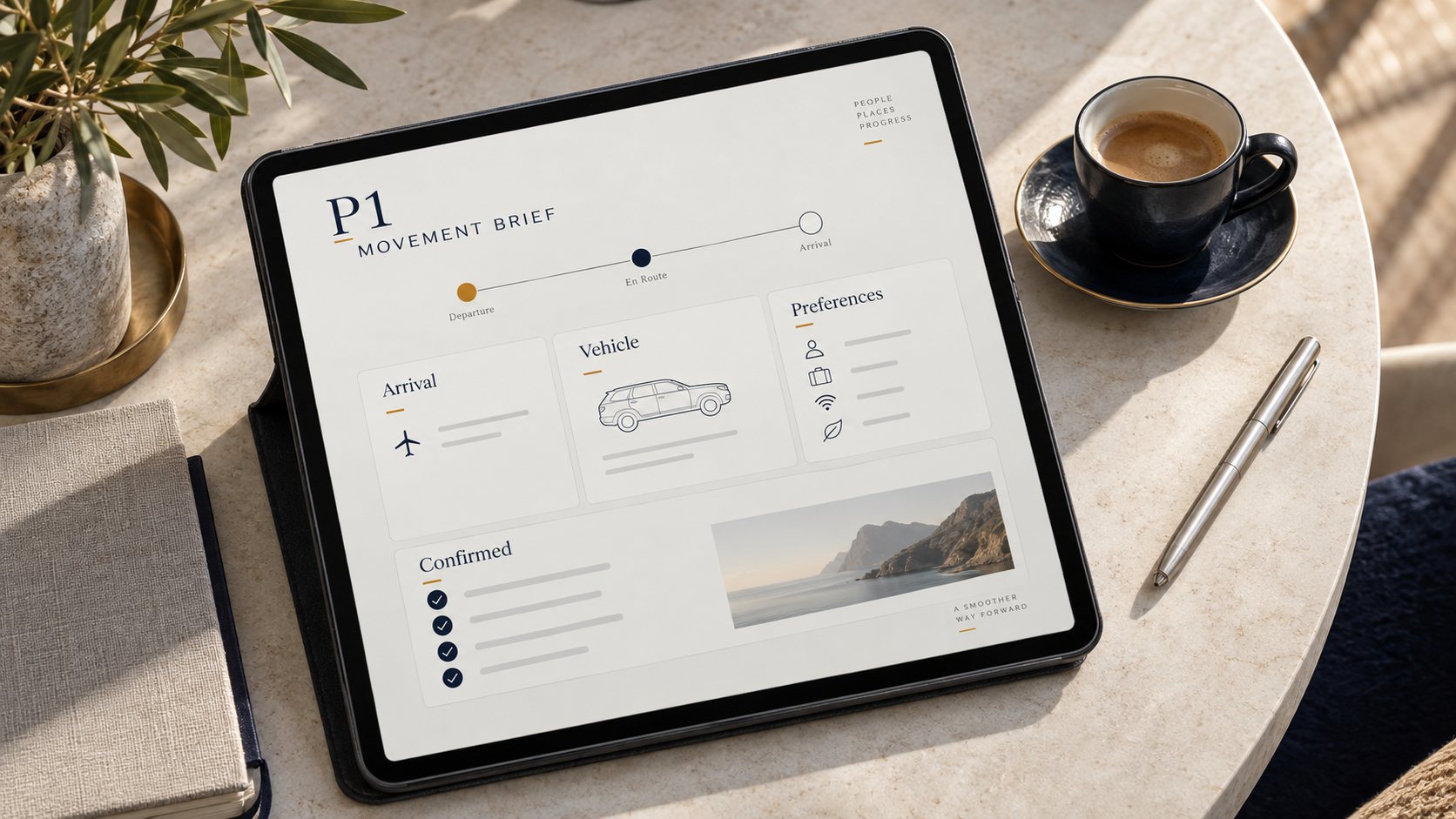
A Movement Brief is a one-page advance briefing, sent about 24 hours before each trip to the people you designate, such as the principal's assistant, security lead, or detail leader. It identifies the driver and their qualifications, the actual vehicle and its verified equipment, the flight, the planned route, relevant weather and road conditions, and the operations contact for the trip. If anything changes, the brief is updated and its recipients are notified, so your team always knows who and what to expect.
No. Assistants, security teams, and other bookers use a secure web portal that opens in any browser, and principals and other contacts receive updates by text message or email, with secure links to the Movement Brief and live tracking. Nothing needs to be installed on anyone's phone or computer.
Authorized contacts receive an update at each milestone, such as the driver staged at the pickup, the principal on board, and arrival, so no one needs to call for a status update. Each person has a communication profile (minimal, standard, or security) that determines which updates they receive and whether they arrive by text, email, or push notification. During a recipient's quiet hours, non-urgent updates are sent by email instead.
A principal who signs in sees a simplified view limited to their own current and next trip: who is driving, the vehicle and its plate, where it is, and a short list of actions that each take two taps. From that view the principal can change the destination, add a stop, keep the vehicle, arrange a later return, request an additional vehicle, or message the operations center. Billing, account administration, and other travelers' trips are never shown.
An assistant or security lead can change the itinerary from the member portal, or the principal can do it in two taps, and the driver and the operations center are alerted to the change. Changes within the limits your account has preapproved go ahead automatically, and anything above those limits goes to your designated approver as a one-tap request. Once a change is accepted, the route, arrival estimate, live tracking, Movement Brief, and prepaid balance all update together.
Only the people you authorize can follow a trip, along with the P1 operations center. Each authorized person receives their own secure tracking link, which by default becomes active when the driver is staged at the pickup and expires one hour after the trip is complete. Links can be revoked at any time, they show the principal's name only if you allow it, and every view is logged.
No. Tracking runs only during a trip, from the moment the driver is en route to the pickup until shortly after arrival, and never outside a trip. Location comes from a managed Samsung phone mounted in the vehicle, not from the driver's personal phone or any device belonging to the principal.
Raw location data is kept for 90 days and then reduced to a route summary and the trip's milestones. P1 handles location data with the same care as banking information: access is limited to the people who need it, every view of sensitive information is logged, and shared links expire. A principal can also ask for their location data to be purged.
Membership
Every trip is paid from one prepaid membership balance, with no tiers and no expiring hours. This section covers how membership works, how P1 compares with a car service or a full protection detail, and how to join.
- account for principals, family, guests, and staff
- 1
- operations center behind every trip
- 24/7
- membership tiers or expiring hours
- 0
- minimum prepaid annual service commitment
- $25k
P1 Membership begins with a minimum $25,000 prepaid annual service commitment. The full amount is available toward eligible P1 services. Member pricing and national network access are provided for an initial 12-month term. Each trip, including any additional agents or vehicles, is paid from the prepaid balance with an itemized receipt, and monthly statements show spending by traveler and by trip.
An executive car service is built around hospitality, and its chauffeurs are hired and trained for service and driving rather than protection. Trips in other cities are often passed to affiliates, so the driver and the standard change from market to market, and there is rarely a brief for your security team or live visibility for the people responsible for the principal. P1 keeps the comfort and simplicity of a car service and puts a security professional at the wheel, with every trip planned, briefed, tracked, and supported around the clock.
A full detail is the right answer for a specific threat or event, but its minimums, staffing commitments, and lead time make it impractical for an airport run, a dinner, or a day of meetings, and several agents and vehicles create a visible footprint. In practice, most principals reserve a detail for a few days a year and travel with a chauffeur the rest of the time. P1 covers those everyday trips with a trained protective presence, and when a day calls for more, close-protection and advance agents can be added under the same membership.
The member rate schedule, rates for additional agents and vehicles, cancellation terms, and the Membership Agreement are shared after you submit a membership request, as part of an introductory conversation about your principals and the markets you travel to. The member rate is the same in every market, there is no surge pricing, and the cost of every trip is shown before it is confirmed.
No. There are no expiring hours and no use-it-or-lose-it balance. The cost of each trip is deducted from the prepaid balance, with an itemized receipt, and when the balance runs low, your billing contacts are notified and can replenish it from the member portal.
Yes. The full amount is available toward eligible P1 services. Additional close-protection and advance agents, on-site ground managers, support and family SUVs, Sprinters, and luggage vehicles all draw on the same prepaid balance, and each appears on its own line of the receipt. Monthly statements break spending down by traveler and by trip.
Yes. A full day with the driver is booked as one trip, from the scheduled pickup to the final drop-off, and a multi-day stay, such as a week in Aspen, can keep the same driver and vehicle throughout. A stay with several vehicles is coordinated as one itinerary, with one brief that covers every day and vehicle, and one statement.
Early termination requests during the initial commitment period are subject to the Membership Agreement and may include an early termination adjustment. If you decide to close your account, your eligible unused balance is returned under the terms of your Membership Agreement.
P1 Membership is by request. After you submit a request, we contact you within one business day to arrange a short introductory call about your principals, the markets you travel to, and how you travel today, and we share the rate schedule and terms. The next steps are the Membership Agreement and your prepaid annual service commitment, a minimum of $25,000. On activation, you receive your P1 card with your account number and the 24/7 operations line, and your bookers receive access to the member portal.
Markets and coverage
P1 operates in Colorado today, and each new market opens to the same standard. Below are the current markets and airports, how travel between markets is billed, and what to do when you need P1 elsewhere.
- Denver and the Front RangeAPA · BJC · DEN
- Aspen and SnowmassASE · EGE · RIL
- Vail, Beaver Creek, and Summit CountyEGE · DEN
- New York and New Jersey
- South Florida
- Los Angeles
- Dallas
P1 operates in Colorado today, serving Denver and the Front Range; Aspen and Snowmass; and Vail, Beaver Creek, and Summit County. The service builds on Summit Executive Transportation and Aspen Security, which have moved principals between Denver, Aspen, Vail, and the region's private aviation terminals for years.
P1 serves arrivals and departures at Centennial (APA), Rocky Mountain Metropolitan (BJC), Denver International (DEN), Aspen/Pitkin County (ASE), Eagle County Regional (EGE), and Rifle Garfield County (RIL). Drivers know the FBO procedures at the airports in their market, and the procedure for each arrival, including the FBO, the entrance, and the meeting point, is set out in the Movement Brief.
The next markets are New York and New Jersey, South Florida, Los Angeles, and Dallas. Each market opens only after certified local providers, along with certified drivers and fully equipped vehicles, are in place and a supervised test trip has been completed, so service there meets the same standard as in Colorado.
Send the location and dates to the operations center, and the team will tell you what can be arranged. If the trip requires a driver or vehicle to be brought in from another market, the operations team confirms the arrangements and any added cost with you before anything is booked.
Yes. Transfers between markets, such as Denver to Aspen or Vail, are a routine part of the service and are booked as intercity trips, with the driver either staying with the principal or returning afterward. Road and weather conditions for the route, including mountain passes, are covered in the Movement Brief, and the operations center monitors the drive from start to finish.
Yes. P1 operates to one written standard for drivers, vehicles, equipment, and procedures in every market, and members receive the same service everywhere. Whichever city the trip is in and whichever driver is assigned, the service is the same, and there are no service tiers. In each market, certified local providers deliver the service, with one operations center and one platform behind every trip.
Working with your team
P1 is built to reduce the work of the people who arrange and oversee a principal's travel. These answers are for executive assistants, security leads, family offices, and flight departments.

P1 is designed for the people responsible for a principal's travel and safety: family offices; corporate security and executive protection teams; executive offices, including assistants, chiefs of staff, and travel managers; flight departments, charter operators, and aircraft management companies; and executive protection firms that need vetted ground support in another city. Because the person arranging a trip is rarely the passenger, the service is built to reduce the work of the people who book, approve, and answer for each trip.
Yes. P1 drivers are trained to work inside an existing detail and understand staging, agent communication, vehicle positioning, lead and follow vehicles, and route changes without needing them explained. The Movement Brief goes to the detail leader before arrival, and the driver's role is to strengthen the detail rather than add another variable for its leader to manage.
Yes. Additional agents and vehicles are booked under the same account, paid from the same prepaid balance, and supported by the same operations center, and each appears on its own line of the receipt. Support and family SUVs, each with a certified driver, carry family members, guests, and staff, and family SUVs can be fitted with child seats on request. Close-protection and advance agents, on-site ground managers, executive and passenger Sprinters, and luggage vehicles are also available for larger groups and multi-day stays.
An assistant books from the member portal by choosing the traveler, whose saved locations and preferences are filled in from their profile, and entering the pickup, the destination, and either a time or the flight the pickup should meet. When a flight is entered, the pickup follows the aircraft's actual arrival. The estimate, including whether the trip is local or intercity, is shown before anything is confirmed, and bookers see only the travelers they are authorized to book for.
Yes. Forward the itinerary by email or upload it as a PDF, and the operations team builds each trip, with the vehicles, agents, and estimates it requires, for you to review and confirm in one step. Nothing is booked until a person on your team confirms it.
A single membership covers principals, family members, guests, and staff. Each person receives access suited to their role: assistants and security teams book for the travelers assigned to them, approvers review requests that exceed your preapproved limits, and travelers receive updates and, if they sign in, a simplified view of their own trips. Preapproved limits allow routine changes, such as adding a stop, to go ahead without a phone call.
Pickups are linked to the flight and follow the aircraft, so an early, late, or diverted arrival re-times the pickup automatically. The FBO procedure is part of the Movement Brief, and pilots and flight coordinators receive a crew link that shows where the vehicle is staged and when the passengers are on their way back to the aircraft. The crew can also post wheels-down and planned departure times, which update the trip and notify your team.

Questions specific to your travel
The operations team can explain anything this page does not cover, from the procedure for a particular FBO arrival to how your first trip would be planned and briefed. Write to us with your question, or request membership to begin the qualification process.